
Fountains & Waterfalls
Water features with sound and movement, on a closed circuit that keeps consumption down.
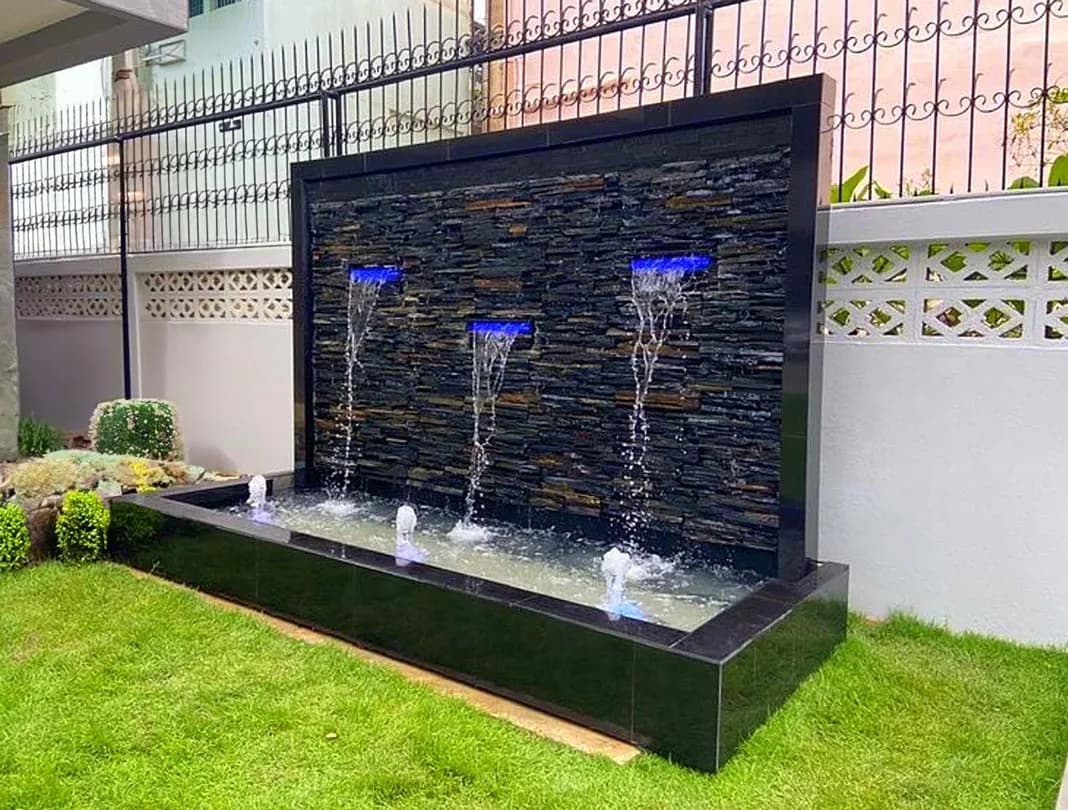
Fountains and waterfalls add sound and movement and lower the perceived temperature around a seating area. We build them on a closed circuit with a correctly sized pump and filtration, so the only loss is evaporation. We also tune the design so the sound is pleasant rather than intrusive, which comes down to fall height and the surface the water runs over.
Sound is the real product
People think of a fountain as a visual element. In practice its biggest effect is acoustic: running water masks street and neighbour noise and changes how the space feels entirely. So deciding the sound you want comes before deciding the look — and fall height plus the surface the water lands on are what control it.
A high fall onto hard stone produces a strong sound that can be intrusive in a small space. A short fall over a stepped surface gives a light trickle. That difference is tuned during commissioning, with water actually running — not on paper.
The loop is closed — consumption is lower than people expect
The most common question is water use, with an assumption that a fountain consumes continuously. In fact water circulates in a closed loop: down into the basin, back to the pump, up again. The only real consumption is evaporation top-up.
That evaporation rises with heat and with designs that throw water into the air. A design with a direct fall loses less than a fountain with a high spray.
The balance tank nobody sees
It must be large enough that the pump never runs dry as the level drops through evaporation. A small tank means the pump reaches a dangerous state within days without a top-up — and running a pump dry destroys it.
Algae is a design matter, not a cleaning one
Warm water in sunlight is an ideal environment for algae. What reduces it: continuous simple filtration, periodic treatment, and a design that permits cleaning. A drain point at the base of the basin turns cleaning from laborious pumping into opening a valve — the difference between a basin that actually gets cleaned and one that gets neglected.
Electricity and water in contact
Every submerged fitting must be rated for continuous immersion, not merely "outdoor use". Low voltage is the standard for water features. The control panel goes somewhere dry and accessible — not buried beside the basin for appearance.
Scope of work
- Fountains and waterfalls on a closed recirculation loop — only top-up water
- Concealed balance tank sized so the pump never runs dry
- Fully waterproofed basin with edges that contain splash
- Pump flow matched to fall height, not a generic pump
- Submerged low-voltage lighting rated for immersion
- Fill and drain points that make routine cleaning practical
How we deliver
Position and type selection
Location chosen by sightlines, desired sound, and proximity to power and water. A fountain beside seating is soothing; the same one under a bedroom window is not.
Basin and waterproofing
Build and fully waterproof the basin or tank, with supply and return pipework and a drain point.
Pump and lighting
Pump with flow matched to fall height, submerged lighting, and a control panel in a dry, accessible position.
Commissioning and tuning
Fill, test run, and tune flow rate and spray angles — tuning happens on site, not on paper.
Frequently asked
Do fountains use a lot of water?
Does the water go cloudy or grow algae?
Will it be noisy?
Can a fountain go on an existing wall?
Should it run all day?
Does it attract mosquitoes?
In the same category



Ready to start your project?
A free site visit anywhere in the UAE within 48 hours — no obligation.