
Play Areas & Courts
Children's areas with safety surfacing, and compact courts for villas and communities.
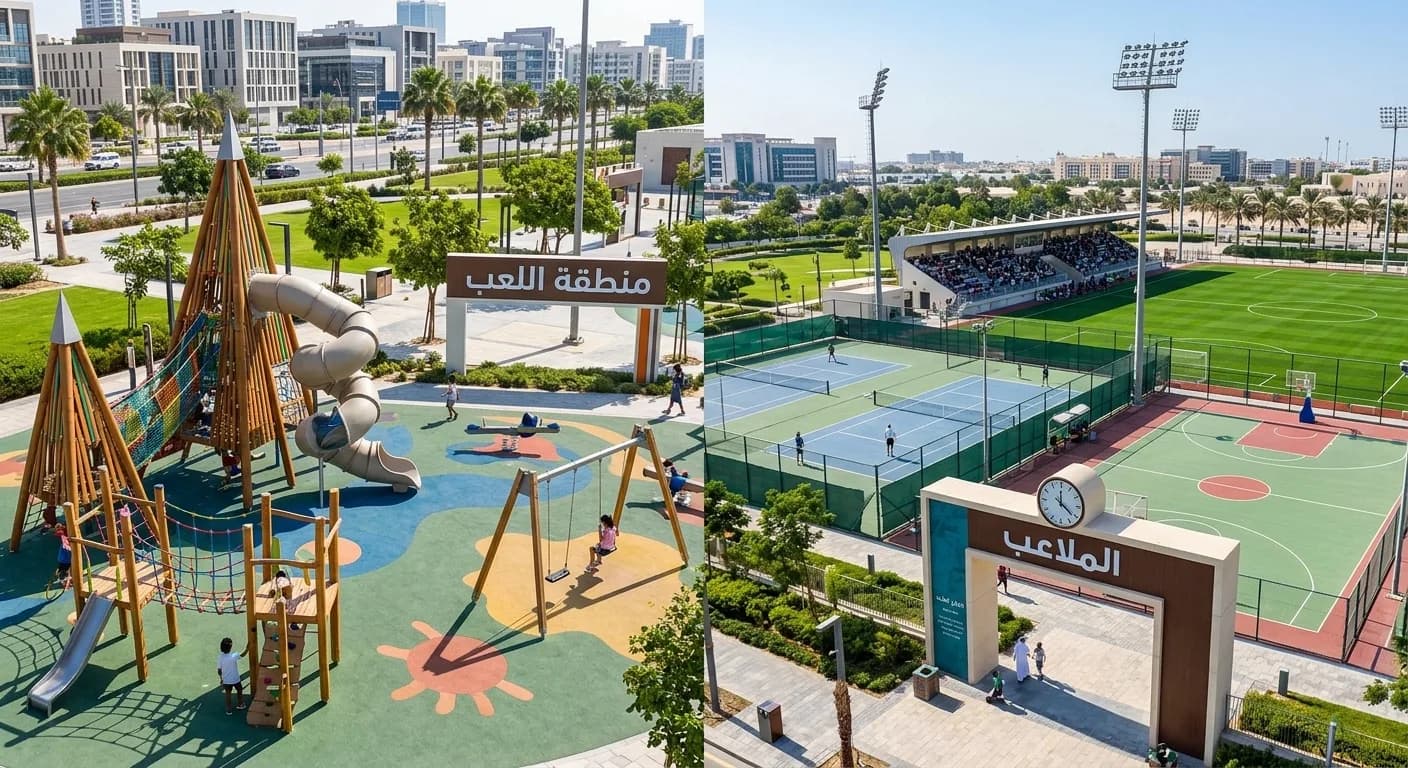
A play area needs impact-absorbing surfacing — rubber or specified sand — at a depth matched to the fall height, safety clearances around each item, and shade, because rubber surfacing gets hot in direct sun. Compact courts are built with sports surfacing, fencing and lighting, with play direction set against the sun and the neighbours.
The surface is the safety equipment
In children's play areas the most important item is not the equipment — it is the surface beneath it. Most serious playground injuries come from falls, and injury severity is decided by how well the surface absorbs impact. So the required thickness is calculated from the free fall height at the highest point of the equipment.
The common error is one uniform thickness across the whole area. It saves cost, but it means the surface under the tallest item is thinner than required — the highest-risk spot gets the least protection.
Heat is a safety issue, not a comfort one
Exposed metal and dark plastics in UAE sun reach temperatures that can burn. Metal slides in particular are hazardous at midday. What reduces it: light colours, grips and contact surfaces in materials that do not store heat, and designed shade over the area. Shade is calculated in the design because it changes where the equipment goes.
Clearances are not a regulatory detail
Every item has a safety zone around it that must stay clear — and its size varies by item. A swing needs far more space in the direction of travel than at its sides. Packing many items into a small area removes those zones and turns the space into a continuous hazard.
Courts: regulation size, or say so
A standard padel court is 20 × 10 metres. Where the available space is smaller, a reduced court is a legitimate option for family use — but we say plainly that it is not regulation, rather than hand over a court whose owner later discovers it does not match the ones they play on elsewhere.
Netting and lighting
Netting height follows the sport and the direction of play, not a single figure. Low netting solves part of the problem and lets the ball through in exactly the situations that annoy neighbours.
Lighting must be distributed so it casts no shadow across the playing area. One strong floodlight from a single side gives powerful light and long shadows — worse than weaker, evenly distributed lighting.
Scope of work
- Rubber or sand surfacing at a thickness matched to fall height
- Safety clearance around each play item by type
- Equipment in materials that do not become too hot to use in sun
- Courts at standard dimensions with surfaces specific to the sport
- Perimeter netting at a height that keeps the ball off neighbours
- Court lighting distributed to avoid shadows across the playing area
How we deliver
Age group and use
Equipment for under-sixes differs from older children, and a family court differs from one used seriously. This sets dimensions, surfacing and clearances.
Surface and base
Compacted, drained base, then the correct surface: rubber at a calculated thickness for play, or a sports surface for courts.
Installation and anchoring
Equipment and posts set in concrete foundations, with netting and enclosure installed at adequate height.
Inspection and handover
Safety clearances, anchoring of every item, and surface edges checked before handover.
Frequently asked
How is rubber thickness determined?
Does equipment get hot in the sun?
What size is a padel court?
Is netting necessary?
Is sand surfacing cheaper?
Can play equipment and a court share one space?
In the same category


Ready to start your project?
A free site visit anywhere in the UAE within 48 hours — no obligation.